Obi, the global real-time aggregator for rideshares, provided Bloomberg with access to its Intelligent Pricing API over several months to help produce a groundbreaking report on the New York City driver lockouts from Uber and Lyft.

The 5,000+ word Bloomberg feature entitled “How Uber and Lyft Used a Loophole to Deny NYC Drivers Millions in Pay” utilized Obi’s real-time data to help examine how the city’s unique pay formula created a perverse incentive for Uber and Lyft to prevent drivers from logging on, even during periods of high demand.
The Bloomberg article highlights that “by making drivers seem busier on paper, the companies set themselves up to save as much as hundreds of millions of dollars in driver payouts, according to Bloomberg estimates — all while telling the drivers, falsely, that the lockouts were required because of the law.”
Without the above lockouts, both Uber and Lyft would have had to pay tens or hundreds of millions of dollars more when the TLC resets the city utilization rate early in 2025.

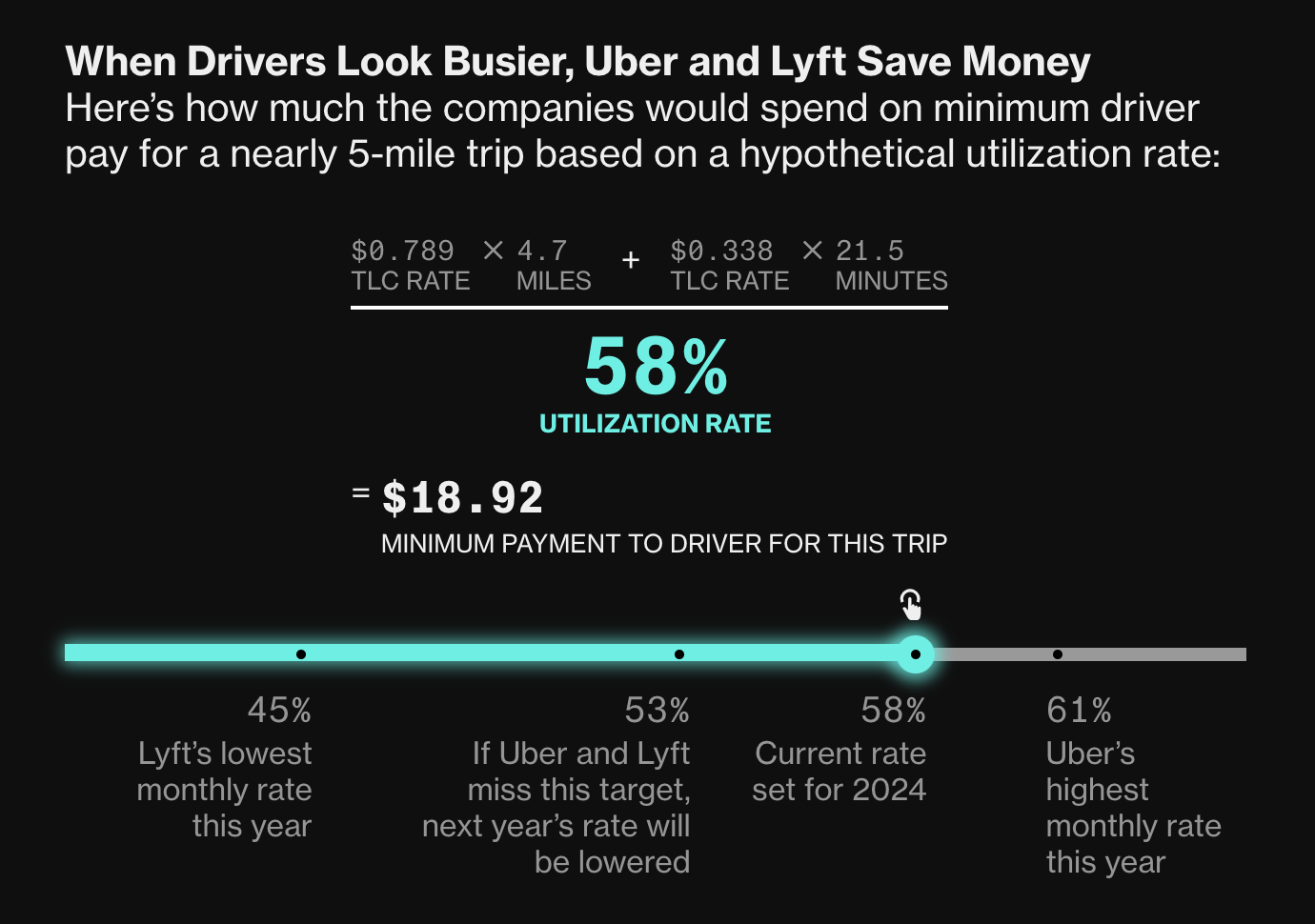
According to Bloomberg, here’s how much the companies would have spent on minimum pay for all rides in the first half of 2024 with each rate:
Uber $1.6B
Lyft $567M
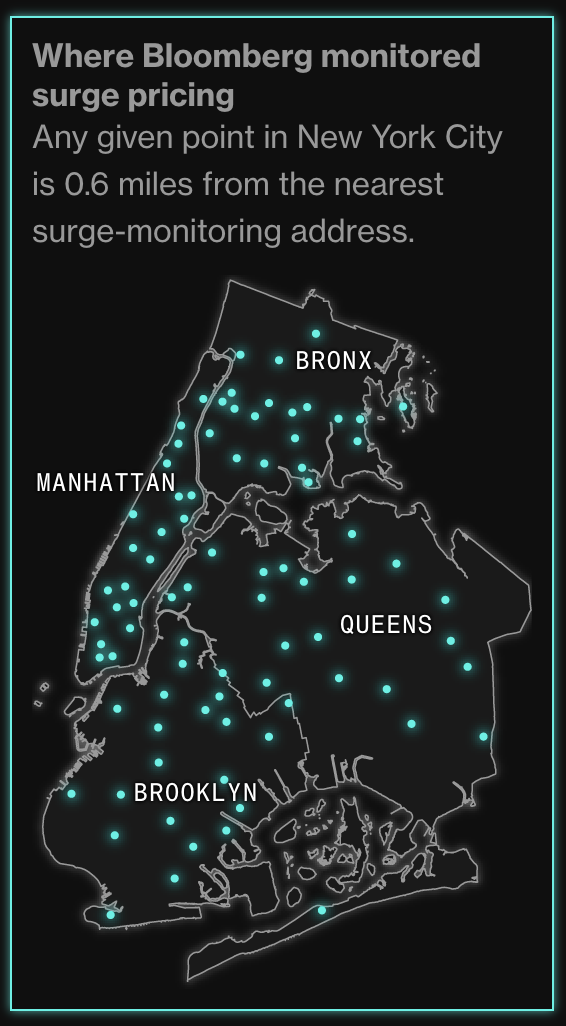
Obi and Bloomberg collaborated over several months to provide hundreds of thousands of data points. Bloomberg News designated a fixed set of 83 randomly selected addresses in Manhattan, Brooklyn, Queens and the Bronx. This number was chosen to maximize coverage throughout the city, while minimizing the burden of data collection.

“Bloomberg approached Obi knowing we were the only organization that could provide the detailed ride data for their investigation,” noted Obi Chief Revenue Officer, Ashwini Anburajan. “Obi’s mission is to help improve pricing transparency in the rideshare market and this is just one example of how our Intelligent Pricing API product can help drivers and consumers alike in exposing complex yet potentially adverse pricing strategies.”
The Bloomberg article highlights include:
The adverse effect on consumers of this pay formula.
By keeping drivers locked out in surge zones, Bloomberg reports the rideshare companies further limited the supply of drivers in a way that may have led to even higher prices for passengers.
Significant Mental Health Impact for Drivers.
Bloomberg interviewed almost 120 drivers, many of whom described the physical, financial and mental health burden of losing a previously predictable stream of income. Drivers reported getting into debt and two drivers even mentioned contemplating suicide as they worried about not being able to support their families.
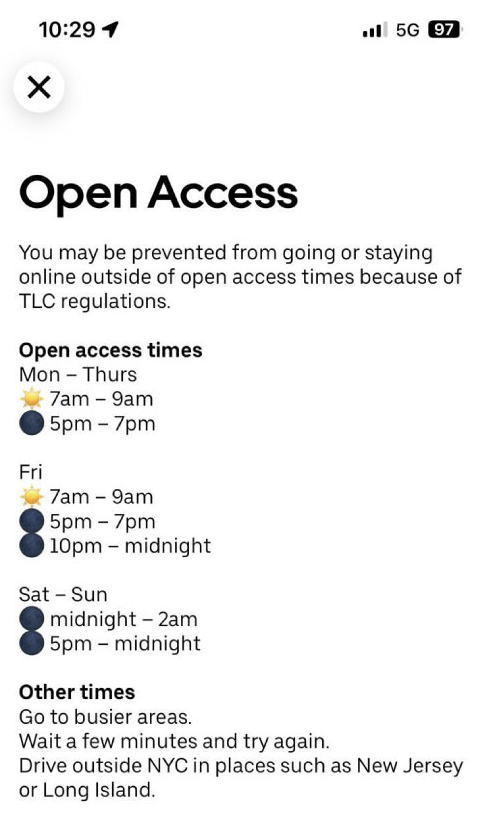
Per the Bloomberg article, whenever drivers get locked out, Uber shows a schedule for what it calls “open access times,” which it describes as hours when they can expect to drive. That includes two hours in the morning and another two in the evening on weekdays, in addition to odd hours on the weekends — a fraction of the hours many drivers worked in a typical week before the lockouts.

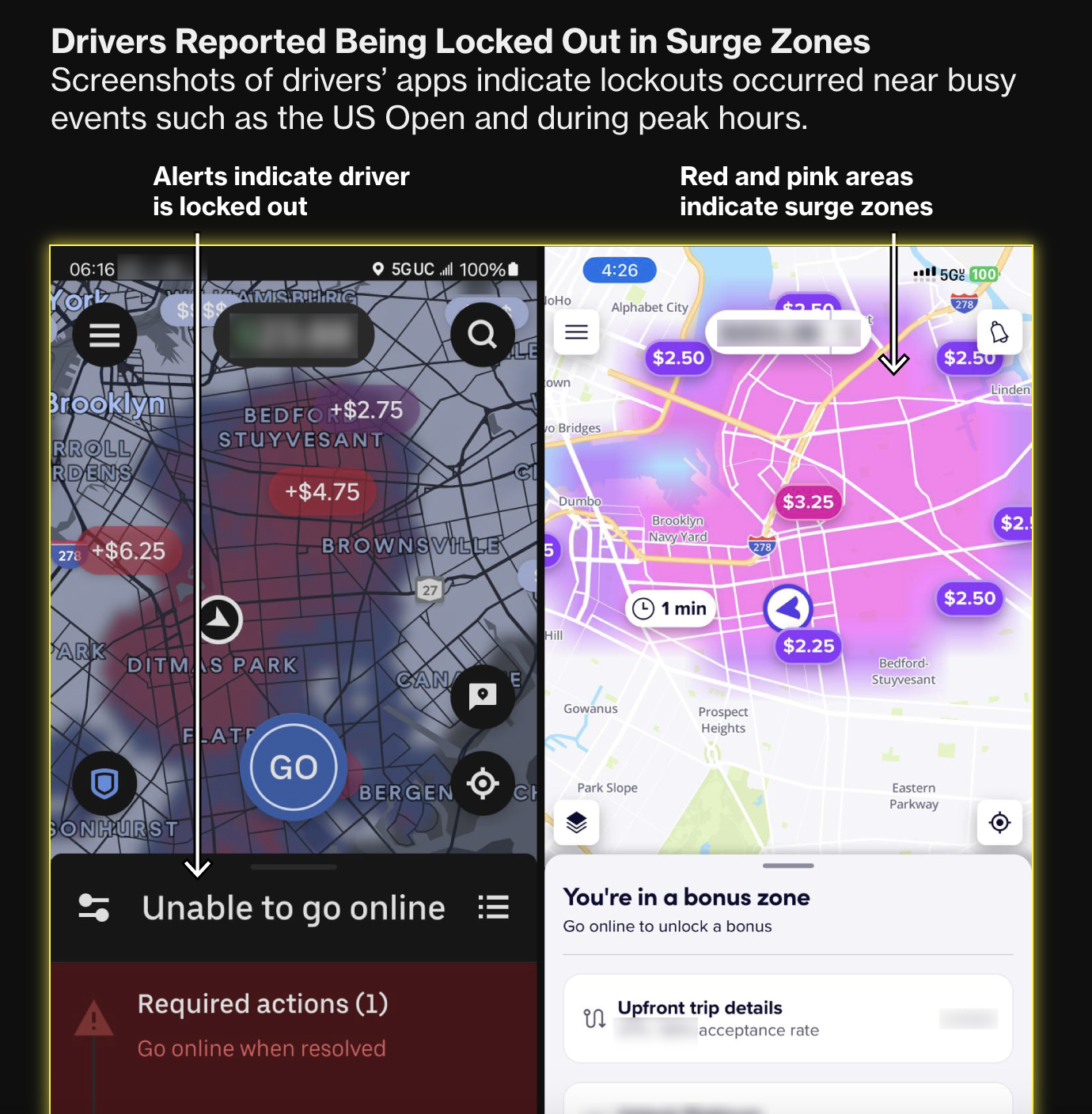
Drivers Reported Being Locked Out in Surge Zones.

Screenshots of drivers’ apps indicate lockouts occurred near busy events such as the US Open and during peak hours. From 3,700 screenshots of lockouts with a discernable location collected for the Bloomberg investigation, more than 430 were reported by drivers near a surge zone. In nearly half (44%) of those cases, surge pricing increased after the lockout occurred.
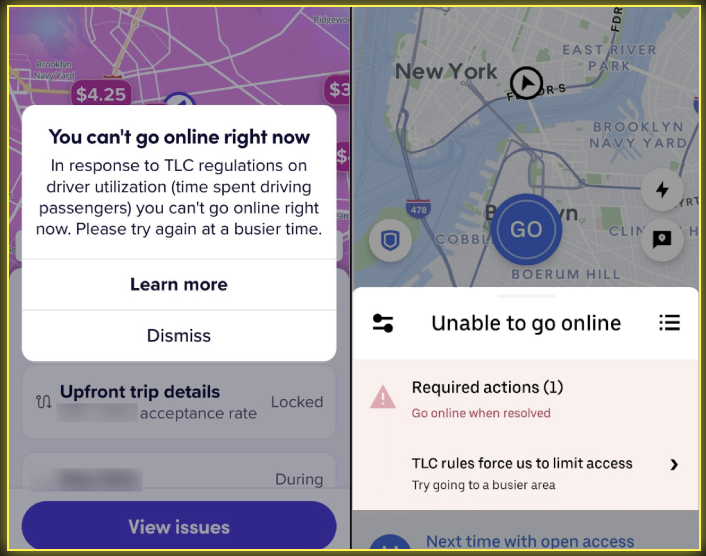
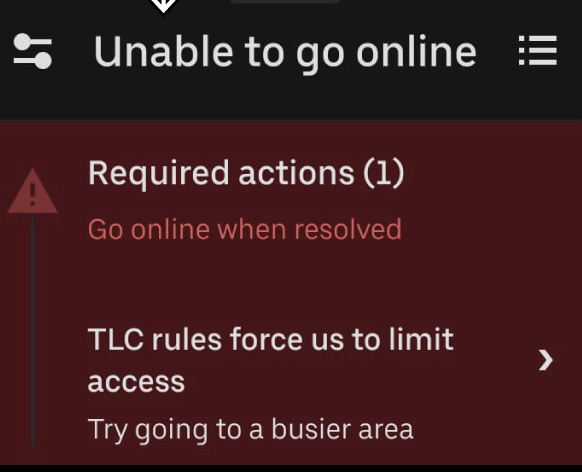
Uber and Lyft framed the lockouts as mandated TLC regulations.

However, TLC regulations do not force the companies to do lockouts. Uber and Lyft adopted the practice in order to save millions on future driver wages, Bloomberg’s analysis found.
A temporary truce has been called, for now at least.
Bloomberg reports that Uber, Lyft, the mayor’s office and TLC agreed in July for Uber to end lockouts in September as long as Lyft did its part in keeping its efficiency rate up. The New York Taxi Workers Alliance calls the private agreement a restraint on competition. Legal representatives for the New York Taxi Workers Alliance, which represents more than 28,000 drivers, allege that the private agreement between the mayor, TLC and Uber and Lyft have allowed the companies to exploit a duopoly and engage in collusion.
Federal officials have begun to take notice.
Commissioner Alvaro Bedoya recently attended a listening session with Uber and Lyft drivers in New York, where he said “these are very serious allegations” that the commission wants to better understand, according to the Bloomberg report. A spokesperson for the Federal Trade Commission declined to comment on whether TLC’s agreement with the rideshare companies is in violation of antitrust laws, and said the agency does not comment on or confirm the existence of investigations. Bedoya, too, said on Monday that his remarks do not necessarily mean the FTC will launch a probe.
“What I can do is promise you that I’m going to take what you’re telling me very seriously,” Bedoya said. “I hear what you’re saying, the investments that you’ve made, financial investments you’ve planned your lives, your families’ lives around these opportunities that were promised to you.”
Locks outs have led to drivers seeking alternative employment.
A number of them told Bloomberg that they have begun looking for other work during the lockouts to supplement their income, including in construction as well as driving for traditional car fleets.
The full report, entitled “How Uber and Lyft Used a Loophole to Deny NYC Drivers Millions in Pay” was written by By Natalie Lung, Leon Yin, Aaron Gordon and Denise Lu from Bloomberg. The full article is available here (note, registration required).
A PDF of the article is available here.
More about Obi:
Obi is a global real-time aggregator that compares millions of pricing and pick-up (ETA) data points, providing consumers and businesses with actionable insights. The free Obi app allows riders to compare taxis, black cars, and major rideshare providers instantly. With over 700,000 users, Obi partners with numerous rideshare and taxi providers worldwide to ensure transparency in ride fares. The app is available for free download on iOS and Android. Rideobi.com